Contextual AI Reranker
Instruction-following reranker for RAG systemsRank search results by your instructions
Highlights
What you can do with it
- A bank optimizing financial document retrieval
- A patent team validating claims with better ranking
- A tech company prioritizing internal documentation
How to use it
- 1 Register for a Contextual AI account
- 2 Find the rerank API in the getting started section
- 3 Write instructions describing your priority rules
- 4 Append the instructions to your query and submit
- 5 Review the results and adjust the instructions
Who it is for
Pros
- Instruction-based control over ranking
- Reported benchmark strength in several domains
- API with documentation and examples
- Works as a drop-in replacement for an existing reranker
Limitations
- Free trial then paid API usage
- Benchmark numbers are the vendor's own reporting
- Needs an existing RAG pipeline and developer work
- Enterprise data handling needs review before use
What Contextual AI Reranker is
Contextual AI Reranker is a model built for enterprise retrieval augmented generation systems. A normal reranker orders results by a relevance score, which means the top result is not always the one you actually want. This model follows natural language instructions instead, so you can tell it to prefer newer documents, a specific source, or a particular document type, and it reorders accordingly. The site reports strong performance on the BEIR benchmark and on internal datasets, especially for multi-hop reasoning, finance, and scientific literature. Access is through an API with documentation and code examples, and it is designed to replace or strengthen a reranker you already have. A free trial is available.
What you can do with it
- Rank retrieval results using your own written instructions.
- Prioritize by document age, source, or type.
- Replace or improve an existing reranker in a RAG pipeline.
- Test the model through the API during the free trial.
Who it is for
- Engineers building enterprise search or RAG systems.
- Teams in finance, legal, and technical knowledge management.
- Developers who need better ordering from an existing pipeline.
What to watch out for
The benchmark figures come from the vendor, so run your own evaluation on your own data before you trust them for a production system. This is not a standalone product: it assumes you already have a retrieval pipeline and someone who can write the integration, which is real developer work rather than a configuration step. Free trial access is followed by paid API usage, so model the cost against your query volume. If your knowledge base contains sensitive enterprise material, review how documents and queries are handled before you send anything through a third-party API.
FAQ
Is there a free trial?
Yes, the site offers a free trial accessed through the API.
How is it different from a normal reranker?
It follows natural language instructions, so you can prioritize by age, source, or document type.
Where do the benchmark numbers come from?
The site cites the BEIR benchmark and its own internal datasets.
Why it is free
What the official page says: free trial
Free limits, trial length and features are decided by the official site and can change at any time.
Product preview
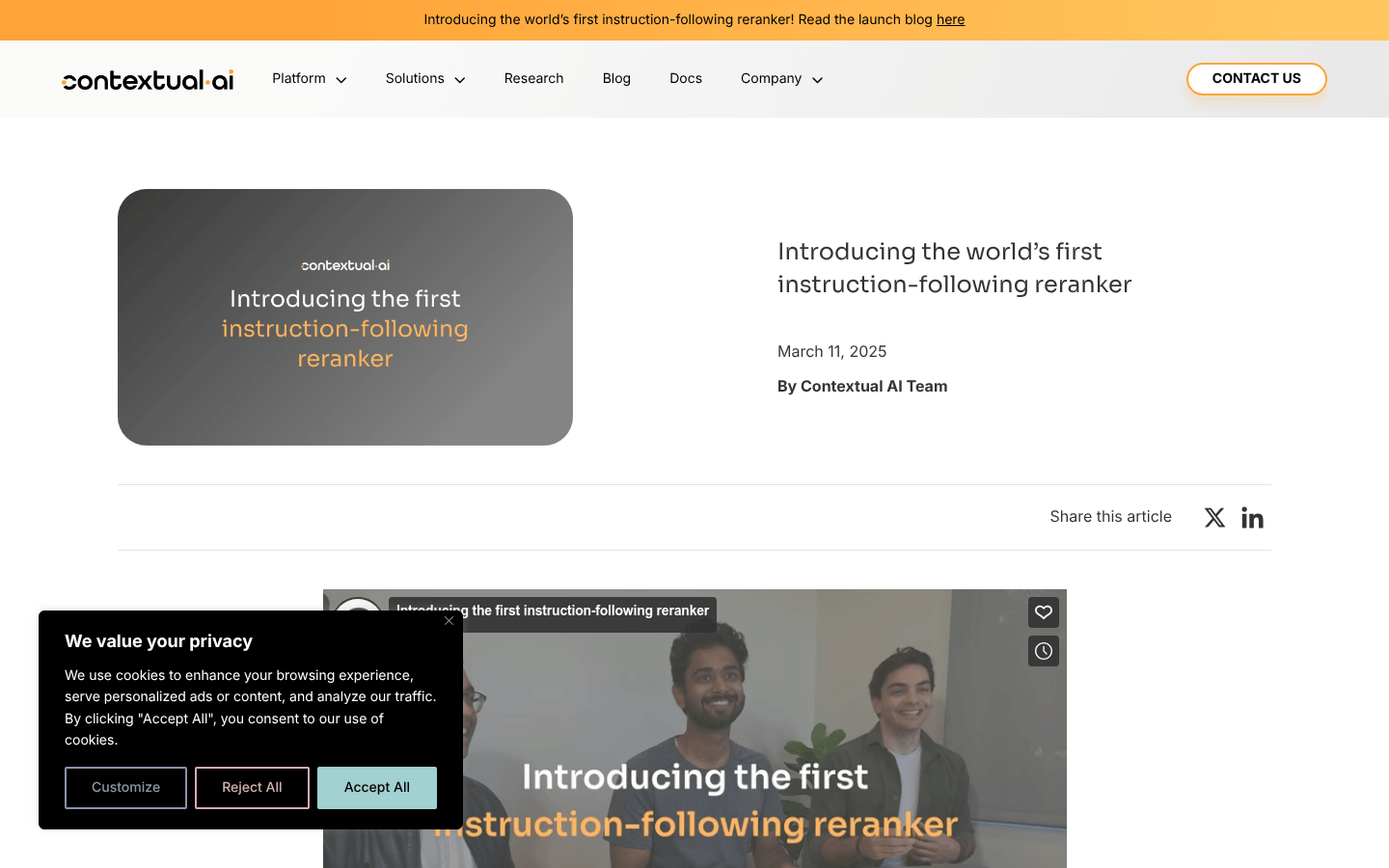
Screenshot archived from the listing page, for preview only.