Ray
Open source framework for AI workloadsScale Python AI work from laptop to cluster
Highlights
What you can do with it
- An enterprise training models on much larger datasets
- A team serving models online at scale
- An organisation moving batch inference onto heterogeneous compute
How to use it
- 1 Visit the Ray website and review the documentation
- 2 Register on Anyscale for the free trial credit
- 3 Work through the tutorials to learn the core concepts
- 4 Pick the libraries you need such as Ray Core, Data or Train
- 5 Deploy a cluster locally or on Anyscale
- 6 Debug and optimise with the provided tools
- 7 Join the community Slack to compare notes
Who it is for
Pros
- One framework across training, serving and batch inference
- Python native, so existing code extends rather than rewrites
- Scales from a single laptop to a large cluster
- Open source with an active community
Limitations
- Distributed systems concepts add real learning cost
- Cluster costs are separate from the framework itself
- Free trial credit is limited and paid platform use follows
- Benchmark improvements quoted by the vendor will not transfer automatically
What Ray is
Ray is an open source framework developed by Anyscale for managing, executing and optimising compute across AI workloads. It is Python native, which means existing Python code can be scaled and distributed rather than rewritten, and it handles both structured and unstructured data including images, video and audio. The libraries cover distributed training, model serving, batch inference, reinforcement learning through Ray RLlib, and end to end generative AI pipelines. It uses heterogeneous GPUs and CPUs with fine grained scaling and runs from a laptop up to clusters of thousands of GPUs.
What you can do with it
- Scale and distribute ordinary Python code across a cluster.
- Train large models, including generative AI base models and traditional machine learning models.
- Serve models and business logic with independent scaling.
- Run offline batch inference across CPUs and GPUs in one pipeline.
- Run reinforcement learning workloads through Ray RLlib.
- Serve and fine-tune large language models for online or batch use.
Who it is for
- AI and machine learning developers building production pipelines.
- Enterprise teams with heavy compute workloads and utilisation problems.
- Researchers processing large datasets and complex models.
- Platform teams standardising how workloads are scheduled and scaled.
What to watch out for
Distributed systems are genuinely hard, and Ray does not remove that: concepts like task scheduling, actor lifecycle and cluster configuration take time to learn, so budget for it. The framework is open source, but cluster compute is a separate cost, and a free trial credit on Anyscale is limited before paid platform use begins. The performance and cost improvements quoted in the listing are vendor examples from specific workloads and will not transfer automatically to yours, so benchmark on your own data before believing them. Finally, operating a cluster brings its own reliability and cost management work, and misconfigured jobs can waste serious money.
FAQ
What is Ray?
An open source framework from Anyscale that manages, executes and optimises compute for AI workloads.
Is it free?
Ray is open source, and a free trial with credit is offered on the Anyscale platform.
What workloads does it cover?
Distributed training, model serving, batch inference, reinforcement learning, generative AI and large language model inference and fine-tuning.
Do I need a cluster to start?
No, the listing says it scales from laptops up to thousands of GPUs.
Who is it for?
AI and machine learning developers, enterprise teams and researchers.
Why it is free
What the official page says: free trial
Free limits, trial length and features are decided by the official site and can change at any time.
Product preview
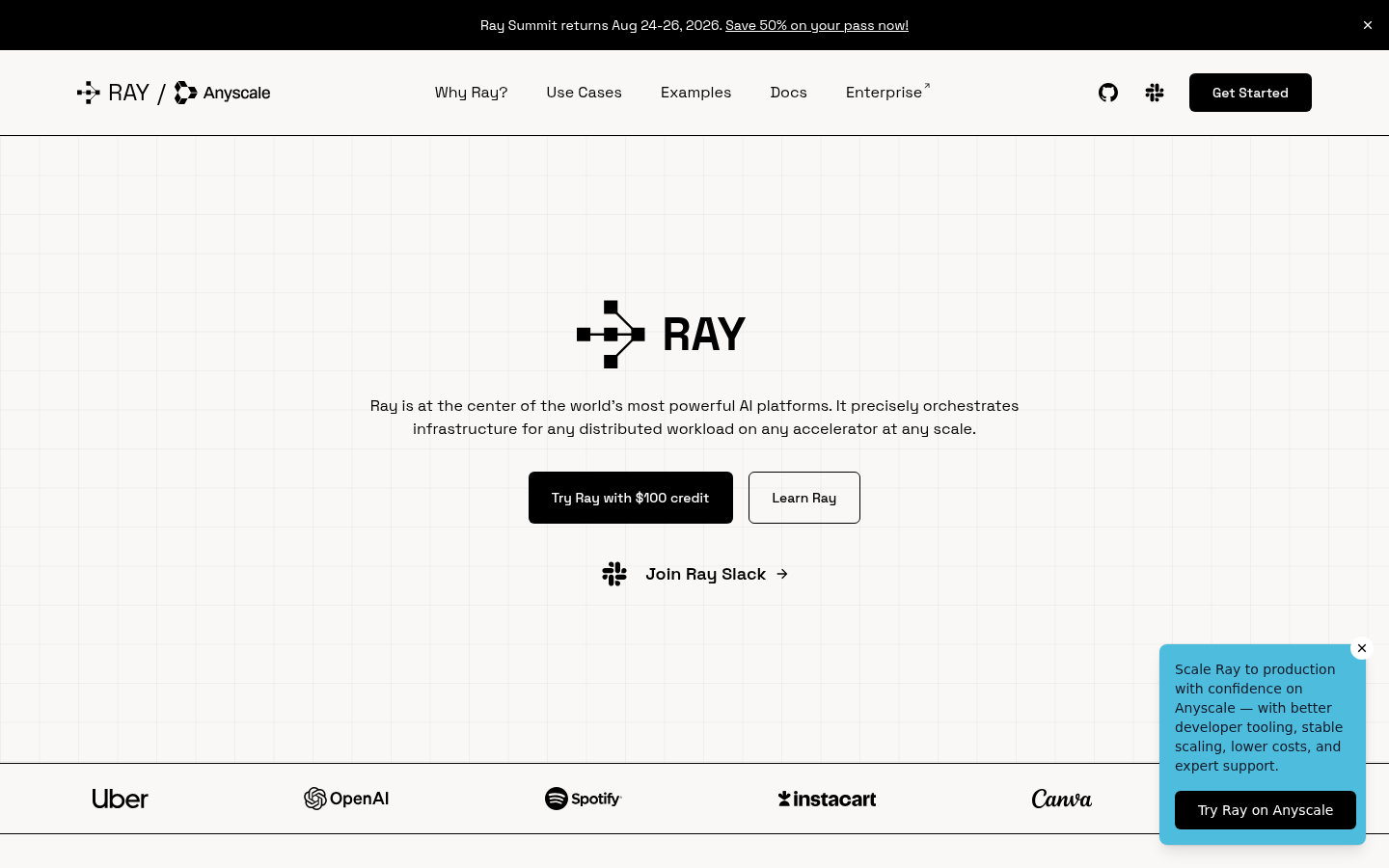
Screenshot archived from the listing page, for preview only.