SearchCans
Google search and page-to-text APIsReal-time SERP data and clean page text
Highlights
What you can do with it
- Build a search assistant that answers from live results
- Assemble a knowledge graph from search and page content
- Feed a RAG pipeline with clean structured text from URLs
How to use it
- 1 Register a SearchCans account and get an API key
- 2 Choose the Google search API or the page-to-text API
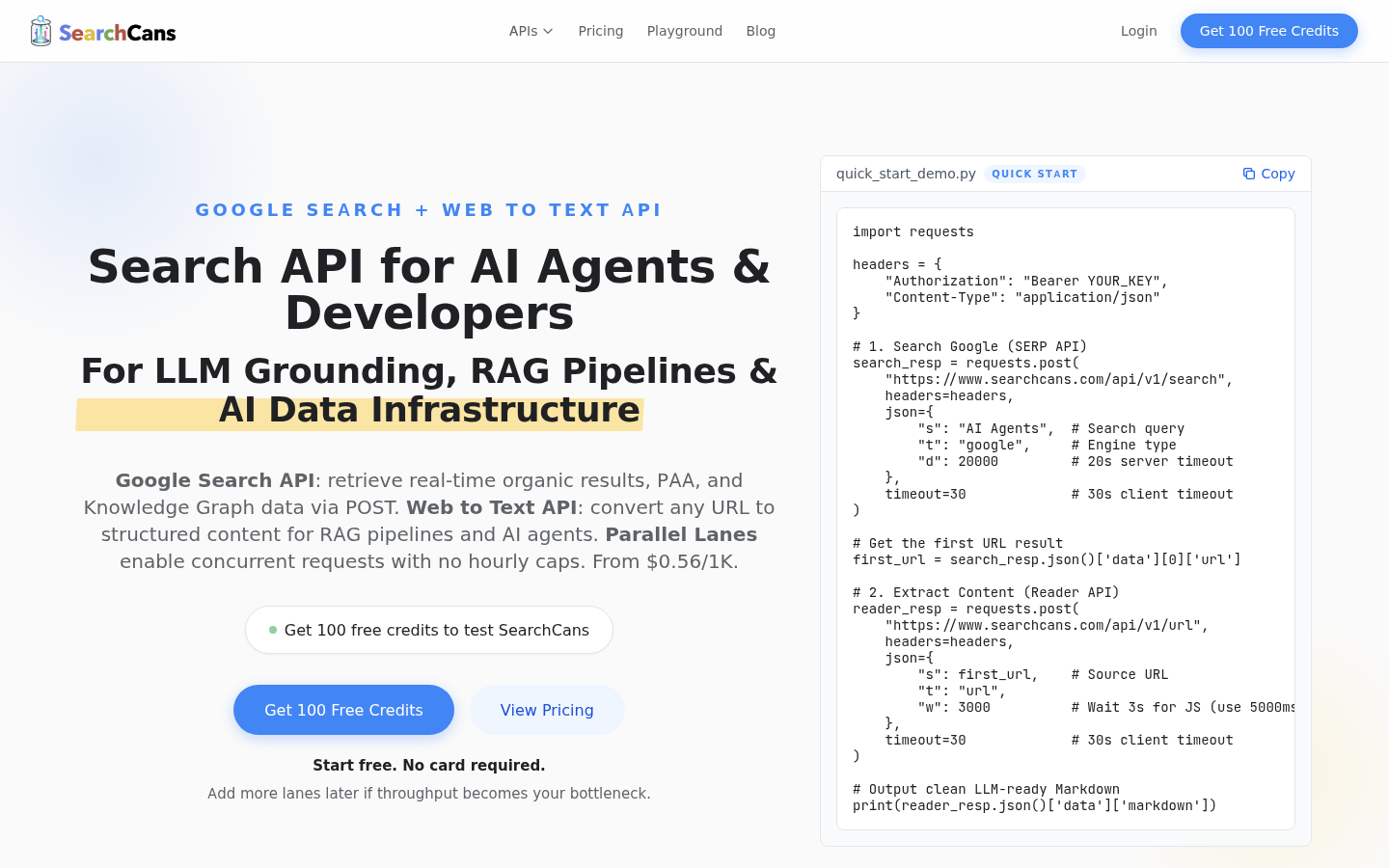
- 3 Send a POST request with the Bearer token and JSON headers
- 4 Set parameters such as the query or URL in the payload
- 5 Process the returned JSON for results or structured text
Who it is for
Pros
- No hourly rate limit simplifies concurrent workloads
- Structured output is ready for RAG pipelines
- Free credits let you test before paying
Limitations
- Free credits are limited to 100 for testing
- Output depends on upstream search result structure that can change
- Paid usage scales with request volume
- API keys need careful handling to avoid abuse
What SearchCans is
SearchCans is a data service built for AI applications, and it exposes two main APIs. The Google search API returns real-time organic search results, People Also Ask content, and knowledge graph data through POST requests, with additional endpoints for Shopping, images, news, and video search. The web page to text API converts any URL into structured content that fits RAG pipelines and AI agents. The service states there is no hourly rate limit and that parallel channels allow concurrent requests. Pricing starts at $0.56 per 1,000 requests, and 100 free credits are provided for testing.
What you can do with it
- Pull real-time organic search results, People Also Ask blocks, and knowledge graph data.
- Convert any URL into clean, structured text for retrieval pipelines.
- Query Google Shopping, images, news, and video search endpoints.
- Run concurrent requests through parallel channels without an hourly cap.
- Authenticate with POST requests, JSON payloads, and Bearer tokens.
Who it is for
- AI developers building search assistants, agents, and RAG products.
- Data scientists who need real web data for training and analysis.
- Enterprise developers whose products depend on fresh search results.
What to watch out for
The 100 free credits are a testing allowance, so production traffic moves onto paid pricing quickly, and costs scale linearly with request volume. Search result structure is controlled by upstream providers and can change, which means parsing code needs maintenance. No rate limit is a convenience, not a license to hammer the service, so build sensible concurrency and retry logic on your side. Finally, keep API keys out of client code and rotate them if they leak, since a stolen key spends your credits.
FAQ
Are there free credits?
Yes, 100 free credits are provided for testing.
Is there a rate limit?
The service states there is no hourly rate limit, and parallel channels allow concurrent requests.
How is authentication handled?
Requests use POST with JSON payloads and Bearer token authentication.
Which search types are available?
Beyond regular Google search, there are endpoints for Shopping, images, news, and video.
Why it is free
What the official page says: free credits
Free limits, trial length and features are decided by the official site and can change at any time.
Product preview
Screenshot archived from the listing page, for preview only.