APIPod
One unified API that connects many AI models for text, image, video, and music.Reach over 100 AI models through a single endpoint, with a free package to start.
Highlights
What you can do with it
- Building an AI agent that chains several models in one request flow
- Batch generating blog copy, marketing text, and social images for a brand
- Producing video from text or image prompts for a creative platform
How to use it
- 1 Register an account on the APIPod site
- 2 Get a free API key from the console
- 3 Pick the model you need from the catalogue
- 4 Point your existing OpenAI SDK compatible code at the APIPod endpoint
- 5 Run tests, then watch logs, token usage, and cost in the observability panel
Who it is for
Pros
- One endpoint replaces several provider integrations
- Free package lets you test before paying
- Routing and circuit breaker logic is handled for you
Limitations
- Free package limits and pay-as-you-go rates can change
- Model availability depends on upstream providers, so a model can disappear
- Wiring routing, keys, and monitoring correctly takes some setup work
What APIPod is
APIPod is an AI API aggregation platform. Rather than registering separately with OpenAI, Anthropic, and Google, you sign up once and reach more than 100 models, including GPT-5.2, Veo 3.1, Nano Banana, and Gemini 3, through one interface. The platform says the API is fully compatible with the OpenAI SDK, which means existing code usually only needs the endpoint and key changed. Coverage spans text, image, video, and music generation, so a single key can serve a chatbot, an image tool, or a video pipeline. Reliability is handled on the platform side through intelligent multi-path routing that spreads requests across backend channels, and circuit breaker protection that trips after three consecutive failures. A free package is available next to pay-as-you-go pricing.
What you can do with it
- Call many models through one endpoint instead of separate integrations
- Mix modalities such as text, image, video, and music in the same project
- Let routing logic spread requests across provider channels for you
- Watch request logs, token statistics, and cost in observability dashboards
Who it is for
- Developers who want one key rather than several provider accounts
- Teams that need failover between model providers
- Creative workers who want image and video models behind one API
What to watch out for
The catalogue depends on upstream model providers, so a specific model can be added, changed, or withdrawn without notice, and your code should handle that gracefully. Free package limits and pay-as-you-go rates are not fixed forever, so check current pricing before you build something that has to stay online. Routing, keys, and monitoring add setup work that a single direct provider account would not, and the observability data is only useful if someone on the team actually reviews it. Treat the platform as an extra layer between your app and the models, and plan for that dependency.
FAQ
Is there a free package?
Yes. APIPod lists a free package, and paid usage follows a pay-as-you-go model.
Do I have to rewrite code written for OpenAI?
APIPod states that its API is fully compatible with the OpenAI SDK, so most code only needs the endpoint and key changed.
What happens if a provider route fails?
The platform watches route health in real time and triggers an automatic 30 second circuit break after three consecutive failures, then retries on other channels.
Why it is free
What the official page says: 免费免费套餐
Free limits, trial length and features are decided by the official site and can change at any time.
Product preview
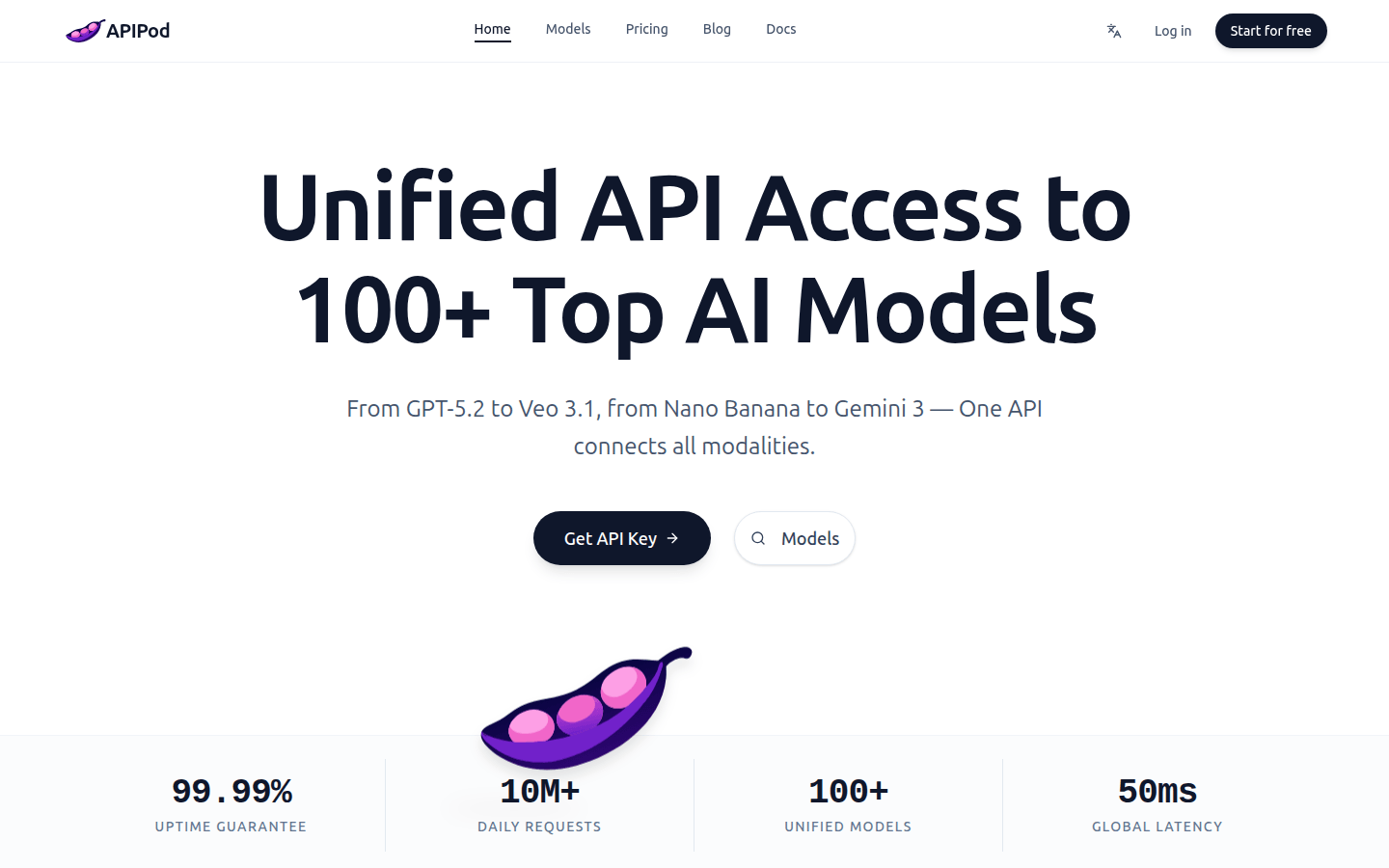
Screenshot archived from the listing page, for preview only.