WeatherNext
Google DeepMind AI weather forecasting technologyFaster forecasts out to 15 days, free for researchers
Highlights
What you can do with it
- Improve heavy rain and hurricane early warnings
- Optimize wind and solar generation scheduling
- Adjust planting schedules against extreme weather risk
How to use it
- 1 Register and log in to the Google Cloud platform.
- 2 Select WeatherNext data in BigQuery or Earth Engine.
- 3 Choose the WeatherNext Graph or WeatherNext Gen model.
- 4 Download real-time or historical data for analysis.
- 5 Use the open-source code for custom development or research.
Who it is for
Pros
- Faster than traditional physical models
- Both single-scenario and ensemble outputs
- Free access and open-source code for research use
Limitations
- Requires a Google Cloud account and some data skills
- Forecasts remain probabilistic and are not guarantees
- Access paths and model names can change upstream
What WeatherNext is
WeatherNext is AI weather forecasting technology developed by Google DeepMind and Google Research. It runs faster than traditional physical models and produces two kinds of output: deterministic forecasts that give a single prediction, and ensemble forecasts that give multiple possible future scenarios. It reaches up to 15 days ahead with a time resolution of up to 6 hours. Real-time forecasts and historical data are served through Google Cloud, including BigQuery and Earth Engine, and the model code is open source. The technology is offered free of charge to scientists and forecasters.
The distinction between the two output types matters in practice. A deterministic run tells you what the model thinks will happen; an ensemble run tells you how confident it is, by showing the range of outcomes it considers plausible. For warning decisions and for energy scheduling, the spread is often as useful as the central estimate, because it tells you how much margin to build in.
What you can do with it
- Pull deterministic or ensemble forecasts out to 15 days
- Access real-time and historical data through Google Cloud
- Support early warnings for heavy rain and hurricanes
- Optimize wind and solar scheduling with better outlooks
- Build on the open-source model code for research
Who it is for
- Meteorological agencies that issue public warnings
- Energy companies balancing renewable generation
- Agricultural planners and academic researchers
- Data teams studying forecast model performance
What to watch out for
Using the data requires a Google Cloud account and enough data handling skill to work with large forecast files, and cloud egress costs can apply beyond the free research access. Forecasts are probabilistic, so an ensemble spread is not a promise, and operational decisions still need a qualified meteorologist. Free access is aimed at scientists and forecasters, and the available models, dataset names, and access routes are controlled by Google and can change. Check current documentation before building anything that depends on a specific endpoint.
FAQ
How far ahead can it forecast?
Up to 15 days, with a time resolution of up to 6 hours.
Who can use it for free?
Scientists and forecasters, according to the listing.
Where does the data live?
On Google Cloud, including BigQuery and Earth Engine.
Why it is free
What the official page says: free of charge
Free limits, trial length and features are decided by the official site and can change at any time.
Product preview
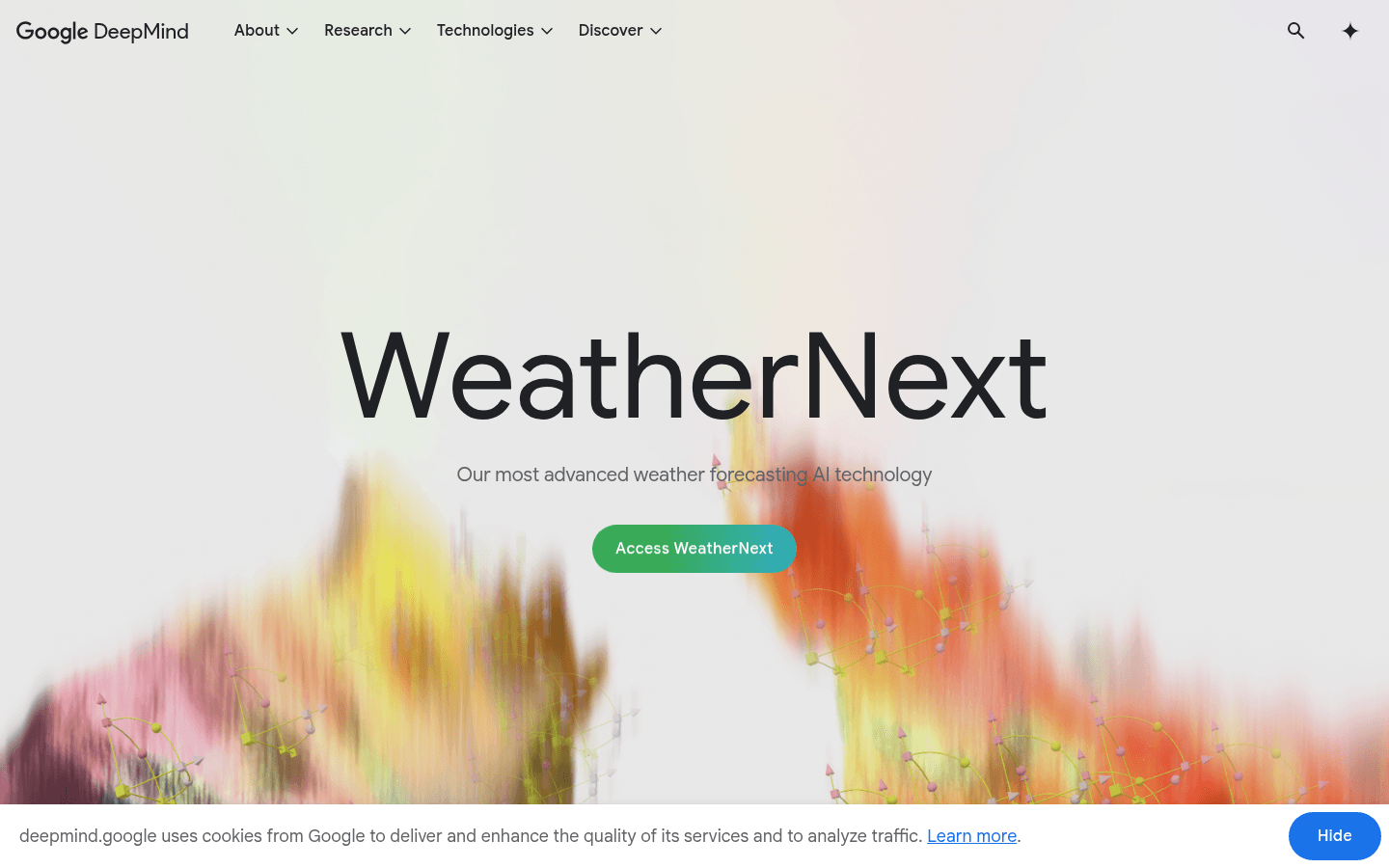
Screenshot archived from the listing page, for preview only.