Miso One
English TTS model with voice cloningExpressive speech at low latency
Highlights
What you can do with it
- Generating voice-overs for videos
- Building low-latency voice agent experiments
- Adding speech output to an application
How to use it
- 1 Visit miso-one.com
- 2 Type the text you want spoken, up to 120 characters on the free plan
- 3 Pick a voice from the library
- 4 Click generate and preview
- 5 Download if you are happy, or upgrade for longer text
Who it is for
Pros
- Free online generation
- Open weights for research
- Low latency for real-time use
- Voice design through prompts
Limitations
- Free plan capped at 120 characters per run
- Voice cloning can be misused: cloning a person without permission may break platform rules or local law, and you carry the consequences
- English only
- The latency figure is an official claim, not an independent measurement
What Miso One is
Miso One is an English text-to-speech model released by Miso Labs with 8B open weights. It is built for expressive conversational speech, meaning the output carries emotional variation instead of sounding flat, and the official claim is latency as low as 110 milliseconds, which matters for real-time voice agents. There is a free online generation service where each run accepts up to 120 characters, and upgrading raises the limit to 1000. Alongside a voice library with different styles and character roles, it supports prompt-based voice design and cloning from a short audio sample. The listing positions it for speech research and creator workflows, and the open weights make it useful to developers who want to run things themselves.
What you can do with it
- Generate expressive English speech from text
- Try it online free, 120 characters per run
- Choose from a library of voices and character roles
- Design voice style and emotion through prompts
- Clone a voice from a small sample, where permitted
- Use the open weights for research or local deployment
Who it is for
- Speech researchers evaluating low-latency agents
- Content creators who need quick voice-overs
- Developers adding speech output to an application
- Teams exploring prompt-based voice design
What to watch out for
Voice cloning is the part that needs care. Cloning a real person's voice without clear permission may break platform rules or local law, and any consequences fall on you, so use only your own voice or audio you are licensed to use. The free plan is capped at 120 characters per run, which is short for real projects, and longer text needs a paid upgrade. The model is English only, so other languages are out of scope. Finally, the 110 millisecond latency is the official claim, so measure it in your own environment before promising real-time performance to users.
FAQ
What is Miso One?
It is an English text-to-speech model from Miso Labs with 8B open weights, aimed at expressive, low-latency speech.
Is there a free plan?
Yes. The free online plan allows 120 characters per generation, and upgrading raises it to 1000.
Can it clone voices?
Yes, from a small audio sample. Only use voices you have permission to clone.
Why it is free
What the official page says: free plan
Free limits, trial length and features are decided by the official site and can change at any time.
Product preview
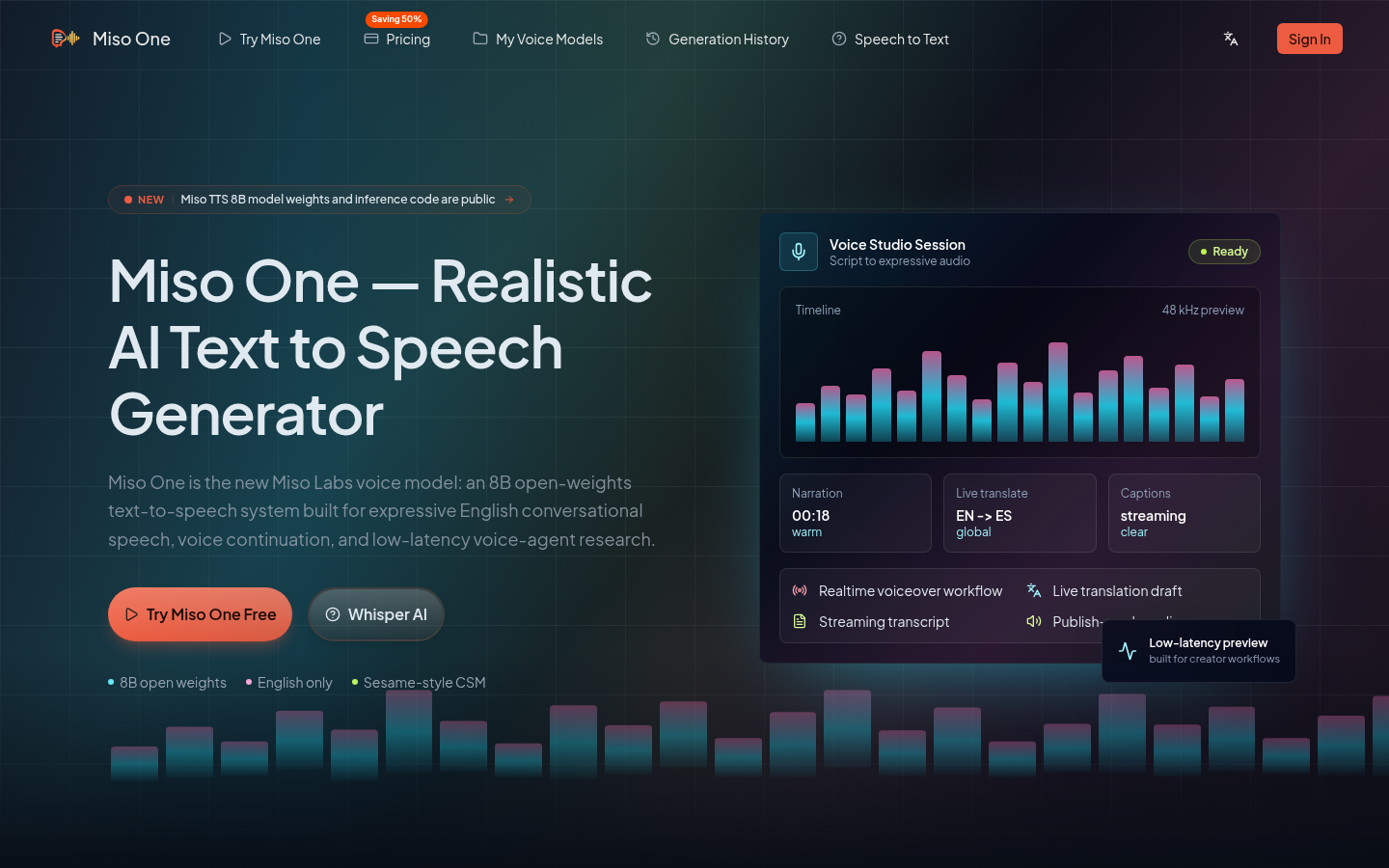
Screenshot archived from the listing page, for preview only.